


Measuring Real MU-MIMO Efficiency in WiFi 7 Networks

The Industry Reality
As WiFi 7 adoption accelerates, network expectations are changing rapidly. Enterprises, service providers, and device manufacturers are now expected to support high-density environments where multiple devices generate simultaneous traffic without compromising user experience.
Technologies like MU-MIMO promise improved spectral efficiency and better multi-user performance by enabling an Access Point (AP) to communicate with multiple clients at the same time. While the theoretical benefits are significant, validating those gains in real-world conditions remains a challenge.
Many WiFi teams can measure peak throughput in isolated scenarios, but understanding actual MU-MIMO behavior under controlled and repeatable conditions remains a challenge. As networks become more complex, engineering and QA teams increasingly require better visibility into multi-user performance, traffic behavior, and scheduler efficiency during WiFi 7 validation.
The Challenges
Validating MU-MIMO performance is not as simple as running a throughput test.
Teams often face challenges such as:
-
- Difficulty measuring real efficiency gains across multiple clients.
- Inconsistent test results caused by environmental conditions.
- Limited visibility into scheduler behavior and packet-level activity.
- Challenges identifying whether throughput improvements are caused by actual MU-MIMO behavior or other RF factors.
Without proper validation, it becomes difficult to confidently assess how efficiently an AP handles simultaneous traffic in dense deployments.
Real-World Validation Scenario
In this validation scenario, a WiFi 7 Access Point was tested using two MU‑MIMO capable WiCheck Golden Clients in an RF-isolated environment.
The objective was to measure the additional throughput achieved when multiple clients received traffic simultaneously compared to individual client performance.
Test Setup
To validate real MU‑MIMO behavior, the test was executed using:
-
- Wi‑Fi 7 Access Point
- Two MU‑MIMO capable WiCheck Golden Clients
- WiCheck Managed Traffic Server
- WiCheck Sniffer
- RF-Isolated Environment
Test Configuration
| Parameter | Configuration |
|---|---|
| Band | 5 GHz |
| Channel | 128 |
| Bandwidth | 160 MHz |
| Traffic Type | TCP / UDP |
| Streams | 8 Parallel Streams |
| Test Environment | RF Isolated |
Test Topology Diagram

Test Methodology
The validation workflow included both individual-client and simultaneous-client traffic analysis.
Phase 1: Individual Client Throughput Validation
-
- Individual WiFi 7 clients were connected separately to the Access Point.
- TCP and UDP downlink traffic tests were executed independently.
- Throughput values were recorded for each client.
Phase 2: Parallel Client Traffic Validation
-
- Both MU‑MIMO capable clients were connected simultaneously.
- Parallel TCP and UDP traffic was generated across both clients.
- Aggregate throughput and efficiency improvements were measured.
Repeatability Validation
-
- Multiple test iterations were executed for both TCP and UDP traffic.
- Packet captures were analyzed to validate actual MU‑MIMO frame behavior.
Validation Results
The test demonstrated measurable efficiency improvements when simultaneous traffic was transmitted across multiple WiFi 7 clients.
Throughput Results
| Traffic Type | Client 1 | Client 2 | Client 1 + 2 Parallel | Efficiency |
|---|---|---|---|---|
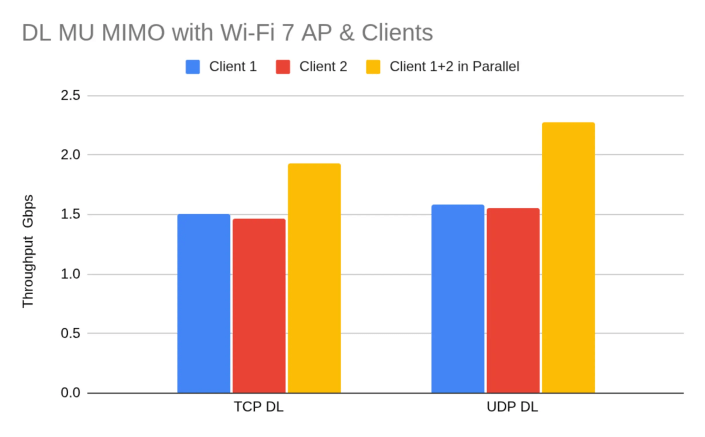
| TCP DL | 1.51 Gbps | 1.47 Gbps | 1.93 Gbps | 29.5% |
| UDP DL | 1.58 Gbps | 1.55 Gbps | 2.28 Gbps | 45.68% |
Results represent the average value across multiple test iterations.
Throughput Comparison Graph
Key Observations
-
- Parallel traffic scenarios demonstrated higher aggregate throughput compared to single-client traffic.
- UDP traffic achieved slightly higher efficiency gains compared to TCP traffic.
- Results confirmed the ability of the AP to deliver simultaneous multi-user transmissions under controlled conditions.
MU‑MIMO Efficiency Analysis
MU‑MIMO efficiency was calculated based on the additional throughput achieved during simultaneous client traffic compared to individual client throughput.
Efficiency = ((T12-(T1+T2)/2)/(T1+T2)/2)*100
Where T12 is the Total throughput achieved when both clients have traffic in parallel.
T1 is the throughput achieved when client 1 is participating alone for traffic.
T2 is the throughput achieved when client 2 is participating alone for traffic.
Observed efficiency values:
-
- TCP Downlink Efficiency: 29.5%
- UDP Downlink Efficiency: 45.68%
Efficiency Graph

Packet-Level MU‑MIMO Validation
In addition to throughput measurements, packet capture analysis was used to validate actual MU‑MIMO transmission behavior.
The packet analysis focused on:
-
- EHT MU PPDU identification
- PPDU type verification
- Compression mode analysis
- QoS data frame validation
- Simultaneous transmission behavior
Engineering teams can use these packet-level insights to confirm whether the Access Point is actively utilizing MU‑MIMO mechanisms during parallel traffic scenarios.
PCAP Analysis Snapshot

EHT MU PPDU,
PPDU type and Compression Mode = 2 for QoS data frames
The WiCheck Solution
WiCheck enables WiFi teams to validate real MU-MIMO efficiency in a controlled RF-isolated environment using WiFi 7 capable Golden Clients, managed traffic generation, and packet-level analysis.
The setup allows engineering teams to:
-
- Measure throughput across individual and simultaneous client traffic scenarios.
- Compare single-client and parallel-client performance.
- Analyze MU-MIMO frame behavior using packet captures.
- Validate scheduler efficiency under repeatable conditions.
- Generate measurable efficiency metrics for TCP and UDP traffic.
Using WiCheck, teams can move beyond theoretical claims and evaluate how effectively an AP handles concurrent traffic streams in practical deployment scenarios.
MU‑MIMO plays a critical role in improving Wi‑Fi 7 network efficiency by enabling simultaneous communication with multiple devices. However, real-world performance gains depend heavily on implementation quality, scheduler behavior, client capability, and RF conditions.
WiCheck provides WiFi teams with a controlled and repeatable framework to analyze MU-MIMO behavior, compare multi-user performance across traffic scenarios, and gain deeper visibility into packet-level transmission characteristics during WiFi 7 validation.
References
https://www.cisco.com/site/us/en/learn/topics/networking/what-is-mu-mimo.html
https://howiwifi.com/2020/07/13/802-11-frame-types-and-formats/


