Broadband OEMs and Service Providers are facing rapidly increasing RMA volumes driven by subscriber churn, Wi-Fi 6/6E/7 upgrade cycles, and shorter device replacement windows. At the same time, sustainability mandates and cost pressures are pushing the industry toward repair, refurbish, and redeploy over discard-and-replace.
But here’s the uncomfortable truth about what’s coming back: industry data consistently shows that the majority of returned broadband customer premises equipment (CPE) devices have no actual fault. Accenture research found that 68% of all consumer electronics returns are classified as No Fault Found (NFF). Analysis specific to networking and telecom devices indicates that only 30–40% of units returned to the RMA centers exhibit permanent, repairable faults, the rest are NFF.
For broadband routers and residential gateways, the picture is equally challenging. Functional issues such as intermittent Wi-Fi dropouts, RF degradation, internet link instability are notoriously difficult to reproduce and diagnose consistently using manual or semi-automated methods. The result: high false-failure rates, unnecessary replacements, and a growing pile of perfectly functional devices being scrapped or sitting idle in warehouses.


Three Market Pressures Turning RMA into a Business Risk
These factors do not just increase testing complexity they directly impact operating costs, capital efficiency, regulatory exposure, and customer experience.
1. Rising Costs of Wi-Fi Access Points, Routers and Residential Gateways Make Every Unnecessary Replacement More Expensive
The economics of broadband customer premises equipment (CPE) have shifted dramatically. Wi-Fi 7 CPE devices carry a significantly higher bill of materials than their Wi-Fi 6 predecessors, driven by tri-band radio architectures, wider 320 MHz channels, 4K-QAM support, Multi-Link Operation (MLO), and the need for multi-gig Ethernet backhaul (2.5G/5G/10G ports). Recent industry analysis shows that memory costs alone, once roughly 3% of CPE BOM, have surged to as much as 20% due to supply constraints, further inflating per unit costs.


As Broadband CPE costs rise with each Wi-Fi generation, the cost of getting RMA testing wrong rises with it. Every misdiagnosed or unnecessarily replaced device adds directly to the CAPEX and reduces margins. Inaccurate RMA testing is no longer just an operational challenge — it is a financial risk that compounds with every new Wi-Fi generation.
2. The Sustainability & Regulatory Compliance Is Real and Growing
The global e-waste crisis has reached a tipping point. The world generated 62 million tonnes of e-waste in 2022, an 82% increase from 2010, with less than a quarter properly collected and recycled. E-waste is projected to hit 82 million tonnes by 2030.
Governments are responding with stricter regulations
-
- The EU Right to Repair Directive, adopted in 2024 and to be enforced by July 2026, mandates that manufacturers offer post-warranty repairs, maintain spare parts availability for up to 10 years, and provide repair manuals and diagnostic tools. Product categories will expand annually.
- Right to Repair legislation is advancing rapidly in the U.S. (California, New York, Oregon, Colorado, Minnesota, and a proposed federal Fair Repair Act) and beyond.
- The EU’s WEEE Directive and Ecodesign for Sustainable Products Regulation further tighten requirements around product lifecycle, recyclability, and repairability scoring.
For OEMs and Service Providers, the message is clear: repair-and-redeploy is no longer optional , it is becoming a compliance requirement. And compliance demands auditable, standardized testing evidence that a repaired device meets quality thresholds before it re-enters the network.
3. Customer Experience and Brand Trust Are on the Line
Redeploying a faulty device, whether misdiagnosed as “no fault found” or inadequately validated post-repair, has cascading consequences: repeat truck rolls, support call escalation, subscriber churn, and brand erosion. In competitive broadband markets, the cost of getting it wrong is not just operational, it’s reputational.
Business Pains
-
- High Turnaround Time (TAT): Manual testing of LAN, WAN, and WLAN takes ~20 minutes per device before diagnosis even begins, creating bottlenecks that extend warehouse dwell time and delay redeployment.
- Limited Depth of Testing: Manual checks confirm port function but miss what matters such as throughput, packet loss, RF performance, and stability under load. Surface-level tests fail to catch intermittent faults that cause repeat RMAs.
- Inconsistent Testing Standards: Without a standardized framework, the same device can receive a different verdict depending on who tests it — leading to unreliable disposition decisions and incomplete fault descriptions.
- Insufficient Test Documentation: Manual methods rarely generate structured logs, making it difficult to track recurring issues, support warranty claims, or provide audit-ready evidence for compliance programs.
- No Root Cause Feedback Loop: Without structured fault data flowing back to design and engineering, the same failure modes repeat and RMA volumes never decrease.
- High OPEX from Inconclusive Testing: When testing can’t deliver a definitive verdict, the default is replacement. High NFF rates drive unnecessary replacements at scale,inflating reverse logistics costs, scrap, and CPE spend.
RMA teams need fast, conclusive fault isolation that delivers the same repeatable results every time, regardless of technician experience, router model, or return volume. In high-throughput RMA environments, inconsistency leads directly to unnecessary replacements, missed intermittent faults, and repeat RMAs.
WiCheck: Optimizing Broadband CPE RMA Testing
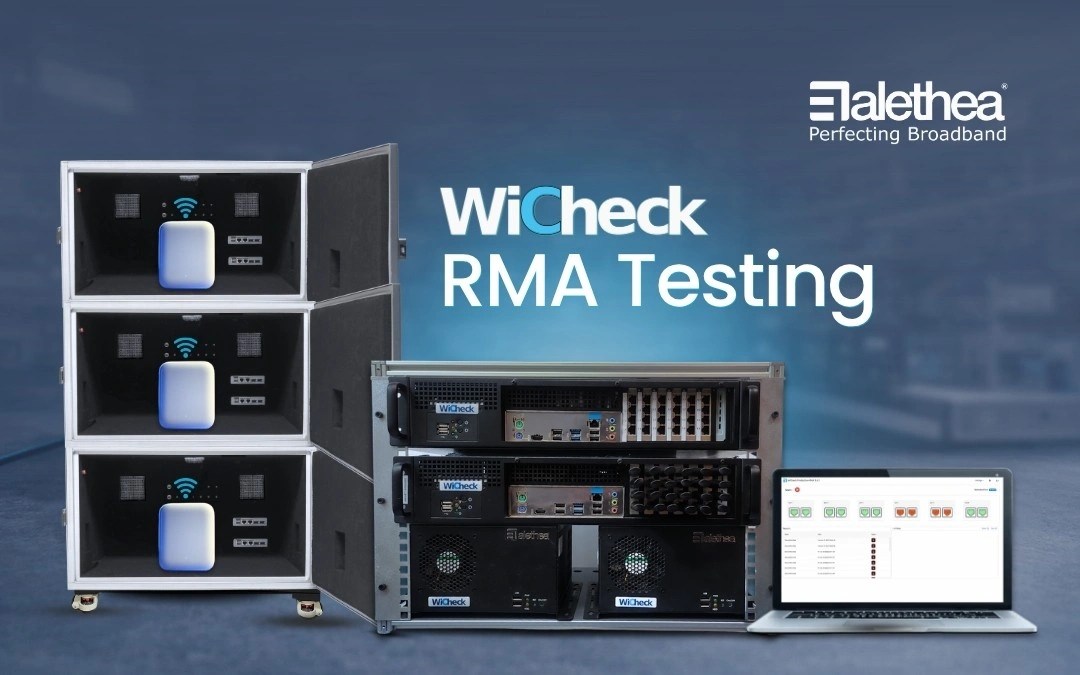
WiCheck standardizes and automates high-volume RMA testing to deliver fast, time-optimized fault isolation without technician dependency. Every broadband CPE device, whether undergoing incoming RMA screening or post-repair validation is tested against benchmarked functional and performance criteria, removing subjectivity from device evaluation and ensuring that fault vs. no-fault decisions are consistent, repeatable, and audit-ready at scale.


In RMA Workflow, WiCheck Guards Two Critical Gates: WiCheck appears at initial fault isolation and post-repair validation, ensuring no device is scrapped without a fair verdict, and no repaired device is redeployed without proof that it works.
WiCheck – RMA Testing Control Dashboard


Intuitive Dashboard: Visual pass/fail indicators simplify test monitoring.
WiCheck – RMA Tester

WiCheck enables RMA refurbishment centers to certify that repaired devices meet defined performance standards required for field redeployment, not just confirm that they power on.
This ensures RMA teams can reduce unnecessary replacements, prevent repeat RMAs, accelerate redeployment cycles, and lower reverse logistics OPEX, supported by audit ready quality records for compliance, SLA reporting, and sustainability initiatives.
RMA Testing Scenarios
-
- Incoming RMA screening at OEM repair centers for fast, accurate fault vs. no-fault classification at intake.
- Service Provider RMA centers validating customer-returned routers and gateways before repair decisions.
- Third-Party Logistics (3PL) facilities processing bulk broadband router returns at scale.
- Post-repair QA in OEM refurbishment centers — ensuring every repaired device meets performance thresholds.
- Redeployment validation before warehouse dispatch — clearing devices for re-entry into the network.
- Certified refurbishment programs for sustainable reuse of broadband devices with auditable test records.
Key WiCheck Capabilities
-
- Automated One-Click Testing: Technician-independent, high-throughput execution.
- Unified Interface Validation: Single-pass Wi-Fi, LAN, and WAN fault detection.
- Root-Cause Classification: Enables repair vs. redeploy decisions.
- Benchmark-Based Certification: Assures refurbished device performance.
- Device-Agnostic Scaling: Rapid onboarding of new Wi-Fi 7 CPEs.
Insights & Reporting
-
- Pass / Fail Classification: Faster RMA dispositioning.
- Interface-Level Performance Metrics: Pinpoint fault visibility.
- Pre- & Post-Repair Validation: Confirms repair effectiveness.
- Redeployment-Ready Reports: Field re-entry certification.
- Audit-Ready Test Logs: Supports QA, SLAs, and warranty decisions.
Business Outcomes Enabled by Standardized RMA Testing
Improving RMA decision accuracy directly reduces avoidable replacement and scrap costs, accelerates device turnaround and supports compliant refurbishment and sustainability initiatives across the organization.
Operations: Minimizes unnecessary device replacements and scrap, lowers reverse logistics costs through improved first-pass RMA accuracy, reduces repeat RMAs caused by NFF devices, and enables faster device turnaround and redeployment.
Quality & Compliance: Delivers standardized, auditable QA evidence required to support certified refurbishment programs, sustainability reporting, and emerging right-to-repair regulations.
Sustainability: Enables scalable repair-and-reuse programs that reduce e-waste, extend device lifecycles, and support corporate ESG commitments with verifiable performance data.
For OEMs and Service Providers, the result is:
-
- Faster RMA decisions.
- Fewer unnecessary replacements.
- Lower reverse logistics costs.
- Greater confidence that only verified, performance-ready devices return to the field.
Reduce No- Fault Found (NFF), validate repairs with confidence and redeploy faster.
Schedule a demonstration of the WiCheck RMA testing solution and see how standardized, automated testing transforms your RMA and refurbishment operations.